Wilson Baby Placed for Adoption in Kcmo 1950s
History of Adoption
Mar 29, 2016
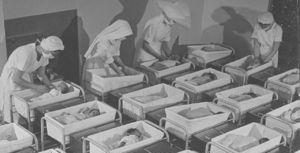
Adoption as it is known today is a relatively new phenomenon, based on European and American legal and cultural definitions of "family unit". Other cultures have dissimilar views about adoption. Some practise not believe information technology is possible to emotionally or socially terminate parental rights; still, other societies and cultures practice their ain forms of substitute child care if a parent is unable or unwilling to parent. Information technology is important to consider the ways these practices accept influenced and shaped current adoption and permanency practices by examining the history of adoption in the The states.
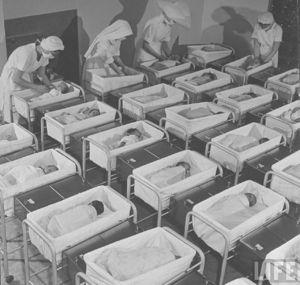
Responses to children without parents
Responses to children without parents take varied. Historically, children's placements take included:
- Boarding and indenture situations
- The church or religious institutions
- Orphanage and asylums
- Babe farms
- Orphan trains
- Native American boarding schools
- Foster homes
- Adoptive homes
From the mid-1800s through the 1920s there was a growing understanding that children were vulnerable. During the Progressive Era in the United States, a concern about kid protection and safety emerged. At the same fourth dimension, kid placement was as much nearly "civilizing" and assimilating what many thought were troublesome ethnic populations as it was virtually child protection.
Views of childhood and children
Prior to the mid 1800's, Children were valued for their economic contribution to the family, not for their emotional contributions. Children were seen as picayune adults and were expected to work at a young age. Children were not seen as a vulnerable population needing protection. It was a mutual practice to identify children with extended relatives, particularly when families were poor. Kid labor laws to protect children from being exploited and exposed to harsh working conditions were not fully passed until 1938. In fact, there were no laws that protected the physical condom of children until the example of x-yr former Mary Ellen Wilson in 1874. Because in that location were no child abuse laws, creature cruelty laws were used to debate for Mary Ellen'south removal and protection from the farthermost physical and emotional abuse inflicted by her adoptive parents. It wasn't until 1960'due south that Dr. Henry Kempe created The Battered Child Syndrome.
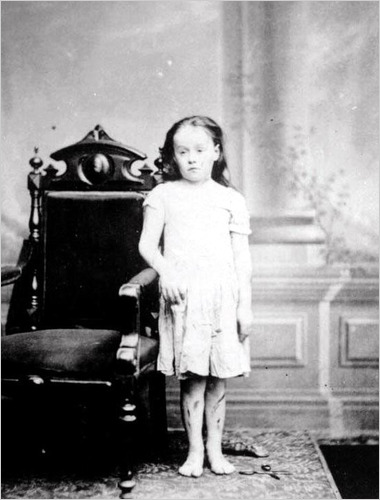
Mary Ellen Wilson
Photograph credit: New York Times, 2009
Progressive Era (late 1800s – 1930s)
From the mid-1800s through the 1920s at that place was a growing understanding that children were vulnerable. During the Progressive Era in the United states, a business concern about kid protection and safety emerged.
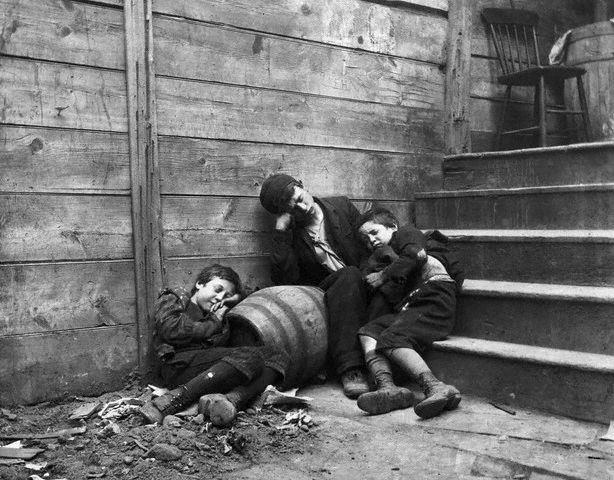 ca. 1890s, New York — Three homeless boys slumber on a stairway in a Lower Due east Side alley.
— Photo by Jacob Riis, Image © Bettmann/Corbis
At the same time, child placement was as much about "civilizing" and assimilating what many thought were troublesome ethnic populations equally it was about child protection.
Boarding and indenture:
Children would sometimes be loaned out to other families where they would piece of work in substitution for room and board. These placements were economical, not placing a child for affection and nurturance.
Sometimes parents would place children within religious institutions, specially churches, where they would work in exchange for room and board.
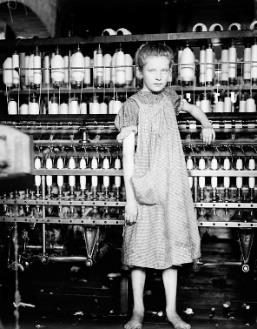 Photo of a 12-twelvemonth old cotton wool mill worker
Photo credit: Eastward. F. Brownish -Library of Congress
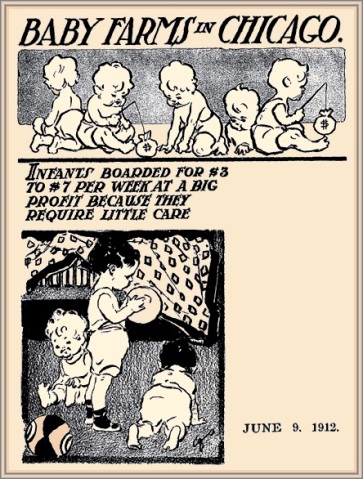
Baby farms
"Baby farms," in which parents could pay a fee to accept someone else take their infant, operated in the U.Southward. until effectually the 1920s. Sociologist Viviana Zelizer reports that the bloodshed charge per unit reached 85-90% at some infant farms.
Orphanages
While children's asylums and orphanages were a system of treatment large numbers of children in poverty, the term "orphanage" has always been a misleading mode to describe institutional care for children since the bulk of children in orphanages had one or more living parents who were unable to intendance for them, commonly considering of issues of poverty.
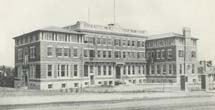 New England Home for Footling Wanderers in the 1910s. From the Adoption History Projection at University of Oregon
Orphanages were idea to be a model of efficiently caring for large numbers of children. Asylums and orphanages were always intended to exist temporary placements – where children could go their basic needs met until family could establish financial stability.
In the mid-1800s, particularly in urban cities like New York, the influx of immigrants led to an overflow of children homeless or placed in orphanages. Concerned humanitarians began to wait for ways to reduce the number of poor children left to fend for themselves.
Orphan Trains
The Orphan Railroad train Movement was i such project. Hundreds of thousands of children were sent by train from large urban cities in the east and placed in foster and adoptive families in farming communities from 1853 to 1929. The phrase "put up for adoption" comes from children existence "put upward" on railroad train platforms for adults to choose from them to foster or prefer.
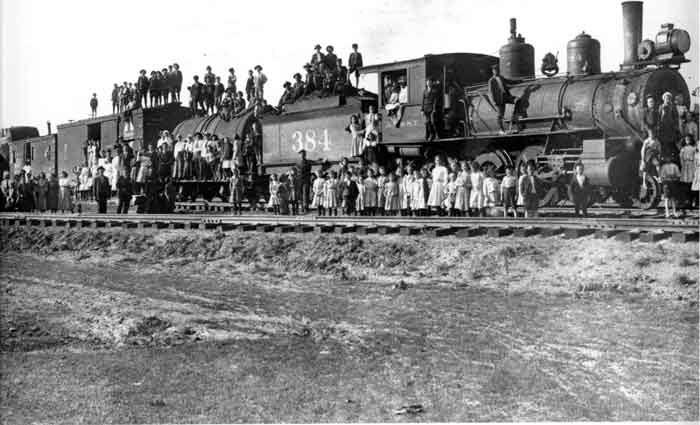 Photo: Kansas Historical Society
Charles Loring Brace, a Presbyterian minister who founded the New York Children's Assist Society, started the Orphan Train Movement.
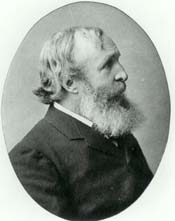 Charles Loring Caryatid
New York Children's Aid Society ,Founder, Orphan Trains
Brace targeted children from immigrant populations that he viewed as unfit or dangerous and documented his views in his volume, The Dangerous Classes of New York. Brace wrote "thousands are the children of poor foreigners, who take permitted them to abound up without school, education, or religion. All the neglect and bad pedagogy and evil instance of a poor class tend to grade others, who equally they mature, not bad the ranks of ruffians and criminals…who become the 'dangerous grade' of our metropolis" (p. 28). Social workers were largely responsible for ending the orphan railroad train movement whose concerns nearly the handling of children in these placements included a lack of home studies and follow upward on how the children were faring. Social workers were also focused on prevention, with assist to children and families through supports like the Female parent's Pensions for widows and so they could afford to keep their children.

The majority of the children placed from the orphan trains were not legally adopted. Nigh children were indentured and chosen to work for families looking for older children who would be able to help economically which is why few babies and infants were placed on orphan trains. Nosotros were yet in the fourth dimension flow of our country that saw children for their economic, not sentimental value.
Social workers were largely responsible for ending the orphan train movement whose concerns virtually the treatment of children in these placements included a lack of abode studies and follow upwardly on how the children were faring. Social workers were also focused on prevention, with assistance to children and families through supports like the Mother's Pensions for widows and so they could beget to keep their children.
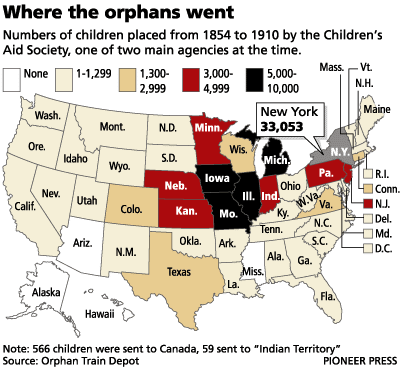 http://world wide web.twincities.com/news/ci_6931904
The Orphan Train Movement was i way that the Us attempted to digest children from populations thought to be un-American. The Native American boarding schools were some other manner. While orphanages were existence dismantled in favor of fostering, indenture and adoption, the boarding schools continued to grow and spread around the country for Indian children. Beginning in the mid-1800s, hundreds of thousands of Native American children were taken from their families and placed into boarding schools run by the government or religious institutions.
Native American boarding schools
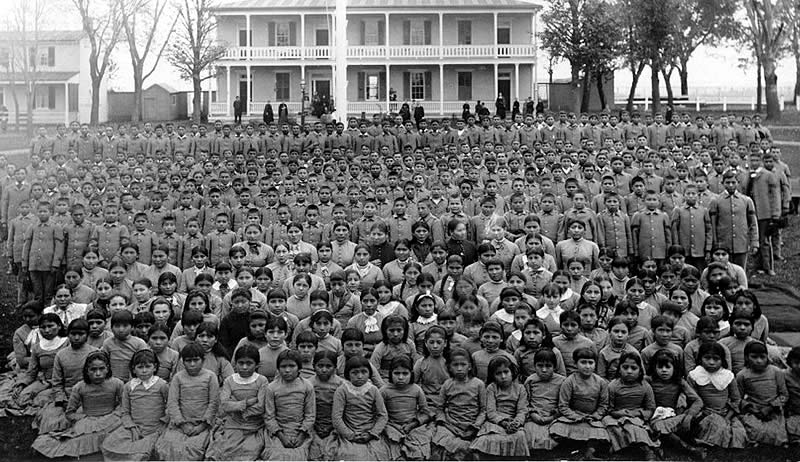 Photo of children at the Carlisle Indian School, the first Native American boarding school
At the boarding schools, children were prohibited from wearing traditional wearable or hairstyle. They were punished for speaking tribal languages or practicing their spiritual traditions. They were forced to have Anglicized names.
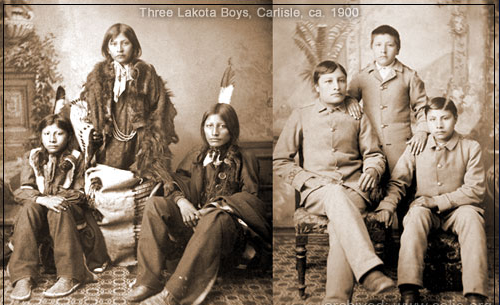 Image from the American Indian Issues: An Introductory and Curricular Guide for Educators:
http://americanindiantah.com/
Assimilation weakened Indian communities by ensuring future generations would not exist able to continue their linguistic communication, traditions, community, spiritual practices and governance. Many children were abused and neglected in the boarding schools and most experienced trauma. Captain Richard Henry Pratt, the military leader who opened the starting time boarding school, Carlisle Indian Industrial School, stated "if you impale the Indian in [the child], you lot save the man." Boarding schools no longer cared for children one time they reached their 18th birthday. Some tried to return to their tribal communities but were unable to assimilate yet they were still discriminated against by European Americans because of their race. The Native American customs nonetheless struggles with the lasting furnishings of the widespread removal of their children, and calls this practise of absorption programs "cultural genocide" and have resulted in generational trauma, passed down through families and communities.
Child Rescue Campaign
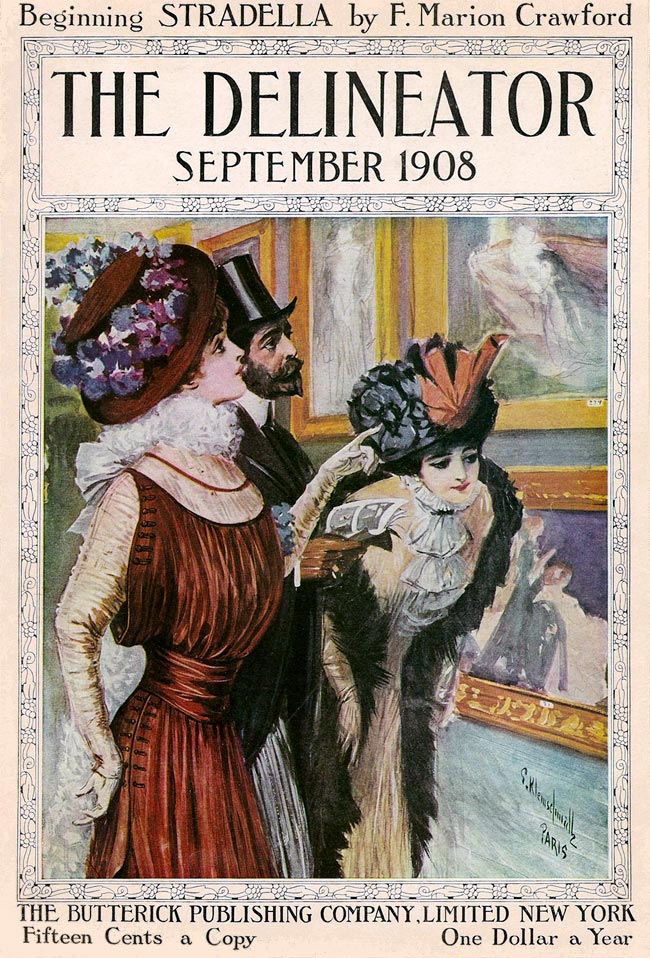
Effectually the same time the orphan trains were running, there were other efforts to increase fostering and adoption. One of the almost public efforts was The Delineator magazine'southward "Child Rescue Campaign." From 1907 to 1911, the popular women's magazine wrote monthly manufactures nearly adoption and featured profiles of children.
In i adoption article the author wrote that "women had the future of society in their hands" through raising skilful citizens (Berebitsky, p. 128). 300 women wrote to the editor requesting to adopt the children profiled in the story.
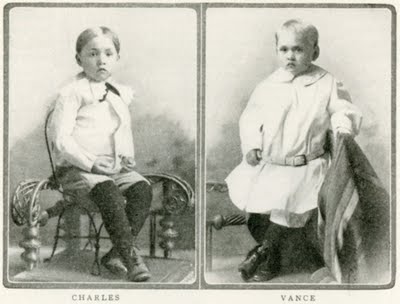
The Kid Rescue campaign posed adoption every bit not only a solution to a social trouble but equally a way to fulfill women's emotional needs to be mothers.
In October 1907 the mag published a story titled "The Child Without a Abode" and the story appealed on emotion and rescue – "deprived of a mother's love, they were a potential threat to society." The Delineator popularized the utilize of the child profile that is still ordinarily used today to inform people about children waiting for adoption.
The "two little faces who look into yours" as written in the periodical, are those of Charles and Vance, who were listed by the Michigan Children'due south Home Guild St. Joseph, Michigan, May two, 1908."
In the aftermath of the Not bad Depression and the end of Globe War Ii, new values well-nigh adoption emerged. The Child Welfare League of America began publishing their "Standards for Adoption Practice" in 1938 to help social workers and child welfare professionals consider best practices in adoption. An increment in family edifice after World War II led to a greater interest in adoption as couples who were unable to conceive children biologically turned to adoption. Adoption was get-go to be seen less equally rescuing children and more about family edifice. Adoption was also seen as the solution to infertility
Concrete resemblance, intellectual similarity, and racial and religious continuity betwixt parents and children were preferred goals in adoptive families" An emphasis was placed on "matching" infants to physically and intellectually resemble their adoptive parents. This practice was believed beneficial because adoption still carried social stigma for both the kid and the adoptive parents. Since the majority of adoption agencies catered to middle-class, married, white couples were challenged by infertility; the need for adoptable infants was high. Children of ethnic minority communities, children with disabilities, or those who were older were considered "unadoptable." As historian Ellen Herman wrote, by matching children to parents, "physical resemblance, intellectual similarity, and racial and religious continuity between parents and children were preferred goals in adoptive families" and then that it appeared a biological relationship, erasing the child'south onetime history.
While matching children in adoption was the practice, there were some notable exceptions:
- Native American children were still actively removed from their families and placed into boarding schools, experiencing forcible assimilation.
- The Child Welfare League of America additionally created the Indian Adoption Project, a program that placed Native American children with White adoptive families, likewise for the purpose of assimilation. The projection ran from 1958 to 1967, placing most 400 children.
Other adoption practices that promoted like behavior nigh adoption as a replacement for a biological family include:
- sealing adoption records and original birth certificates
- de-identifying information nigh the child'south biological family
- issuing amended birth certificates with the adoptive parents named as biological parents
- the do of airtight adoptions where biological parents did not have time to come access to the child they placed for adoption.
Motherhood Homes
Motherhood homes were originally created as a rehabilitative resource for unmarried significant women. Nigh maternity homes were operated past religious organizations every bit a place where single pregnant women would receive parenting and job-preparation skills so they could support and parent their kid. . Parenting the kid was the end goal of the maternity homes. Adoption was not the preferred option for women in motherhood homes until social work professionals began to staff and manage the homes. According to Regina Kunzel, a historian of the maternity home era,whereas the previous idea was that unmarried meaning women were victims of unscrupulous men, now the victims were the children of sexually immoral women.
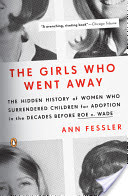
This was the beginning of the negative views most nascence parents. Ann Fessler's book documenting first-hand accounts of women's experiences in motherhood homes reveals the deep shame, stigma and pain that these women felt. Many of the women felt they had no option but to identify their child for adoption because of the pressure level they received past their families and communities.
Historical perspectives 1950s-1970s
Starting in the 1950s widespread social activism such as the civil rights, feminist and disability rights movements began to impact attitudes and practices in adoption and permanency.
The focus on protecting children once once again emerged when Dr. Henry Kempe wrote The Battered Child Syndrome in 1962. His book garnered attention toward child corruption, and as a result, foster care placements increased as many more than children were removed from abusive and neglectful homes.
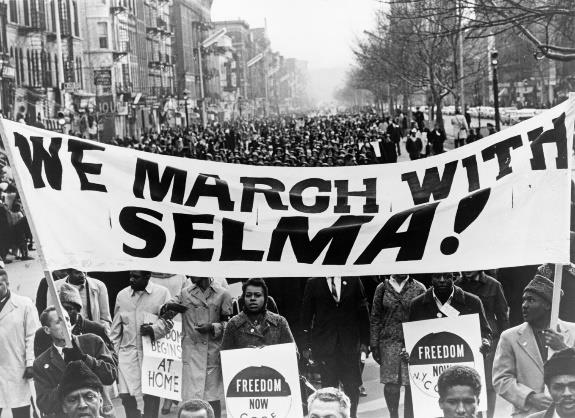 A protest of fifteen,000 people gather in Harlem, March 1965 (Library of Congress)
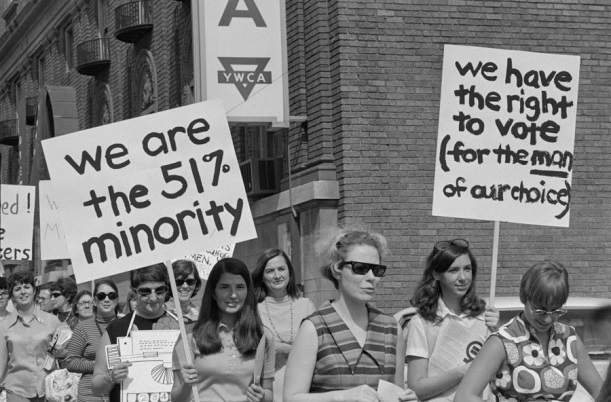 Protesting for the Equal Rights Subpoena. Photo: Bettmann/Corbis/AP Images
The placement of children with disabilities into institutional care was challenged during this time period as well, as parents began to advocate for back up to heighten their children. A 1972 expose of Willowbrook State School in New York revealed the abusive and horrific living weather in institutions, prompting de-institutionalization.
The affect of Roe vs. Wade, along with the availability of nativity control and a lessened stigma on single motherhood, led to a subtract in the number of infants placed for adoption. The civil rights move also influenced adoption. As a response to the Native American boarding schools and the Indian Adoption Project, the Indian Child Welfare Act of 1978 was passed to allow tribes jurisdiction over placement of Native American children.
The National Association of Blackness Social Workers advocated against transracial adoption of Black children into White homes in a 1972 position argument.
Women who were residents in maternity homes formed a group called Concerned United Birthmothers (CUB) to support other nativity parents who had lost children through adoption.
International Adoptions
Intercountry (besides known every bit international or transnational) adoptions began correct later World War II. The first children adopted to the U.Due south. were from Germany, Greece and Japan. The next groups of children adopted internationally were from Republic of korea in the 1950s, and Taiwan and Vietnam in the 1960s and 1970s. Many African American and other ethnic minority children and families were excluded from mainstream adoption and permanency services. In the 1950s, the National Urban League created a program called Adopt-A-Kid, reaching out to Black and Puerto Rican communities for adoption. At the same time, some white families began to seek adoption of children of color. The first documented transracial adoption of a blackness child into a white family occurred in 1948 in Minnesota.
Since the 1980s we have seen some significant shifts in how we view and do adoptions.
There has been an increased focus on "special needs" adoptions.
- The term "hard to place" was changed to "special needs" in order to lessen the belief that some children were unadoptable.
- Federal incentives such as adoption subsidies were created to help increase the adoption of children with special needs.
- Special needs includes characteristics that may hinder a kid's adoption such as the child's historic period, race, inability or membership within a sibling grouping.
Special attention has been focused around prioritizing keeping siblings together in placement.
- Historically it was common to place siblings in dissever adoptive homes. Recognition that information technology is traumatic for children to be separated from their siblings has led to a greater priority to keep siblings together.
Focus on reducing foster care "migrate."
By the 1990s, information technology was recognized that also many children were in "foster care drift" meaning they were lingering in foster care and oftentimes remaining until they turned xviii, never returning to their families or beingness adopted. Laws prioritizing permanency were passed to reduce foster care drift and to provide children with greater security and sense of family. Concerns nearly the outcomes of children crumbling out foster intendance without permanency accept also contributed a greater accent on permanency.
Along with a change in thinking nearly what makes a kid "adoptable" in that location has been an expansion in thinking about what kind of parent should be allowed to prefer. Adoptive parents in the past had to be a married, heterosexual couple without any disabilities. Today, persons who are single, identify as LGBTQ, or with disabilities are adopting children still some prospective parents still experience bigotry in the adoption process.
Since the 1980s, transracial adoptions have been increasingly more common.
- Since 1994, federal laws have prohibited child welfare agencies from delaying or denying the placement of children in foster care for adoption based on race.
- These laws do non utilise to private adoptions, however many children are adopted transracially through private adoptions.
- In addition, from the 1980s until 2004 the numbers of intercountry adoptions grew at high rates.
- Since 2004 however, when over 22,000 children were adopted to the U.South., the numbers of intercountry adoptions have declined due to a number of factors.
Since the 1930s the belief and practice effectually adoption was to preserve privacy and secrecy. In the past few decades, in that location has been a meaning change in this view. More than and more, transparency and openness is being expert in adoption. In that location has been an increase in nascency parents choosing to accept open adoption relationships with their child and adoptive parents. As well, led by adopted individuals, at that place has been activism effectually unsealing adoption and original nascence records.
In summary, the practice of adoption today is unlike in some ways from how we have practiced it in the past, still some aspects remain the same or similar. Although lessons have been learned and improvements in practice have been implemented, there remain areas of growth throughout the permanency and adoption process.
Source: https://www.vtadoption.org/history-of-adoption.html
0 Response to "Wilson Baby Placed for Adoption in Kcmo 1950s"
แสดงความคิดเห็น